
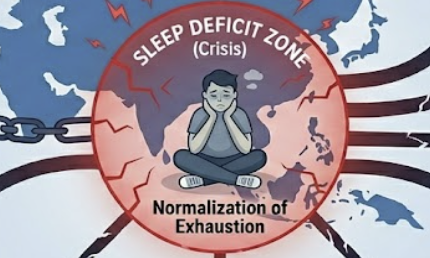
Sleep Deprivation: The Invisible Student Crisis
In the world of high school and college, sleep is often treated like a luxury or a “bonus” feature of the day. We’ve all seen it: the student who stays up until 3:00 AM studying for a chem midterm is praised for their “grind” and dedication. Somewhere along the line, we turned exhaustion into a status symbol. But this mindset hides a painful reality. Sleep deprivation isn’t just a sign of a busy schedule; it’s a full-blown health crisis that is quietly hollowing out student well-being.
The Overloaded Life
Why are we so tired? It’s rarely just one thing. Modern student life is a high-stakes balancing act. Between maintaining a GPA, juggling extracurriculars, managing family expectations, and keeping up with a social life, the “to-do” list never actually ends.
Then, there’s the digital tether. Even when the homework is finally done, our brains don’t just “switch off.” We spend another hour scrolling or messaging because we’re wired for stimulation. By the time the lights go out, the sun is nearly up, but the school bell doesn’t care—it still rings at 7:30 AM.
A Tired Brain Can’t Learn
The irony of the “all-nighter” is that it actually works against you. Sleep is when your brain files away everything you learned that day. Without it, your brain is like a saturated sponge—it can’t soak up anything new.
-
Focus vanishes: You find yourself staring at the same page for twenty minutes.
-
Memory slips: Facts that seemed clear at midnight are gone by the 8:00 AM exam.
-
Efficiency drops: You spend four hours doing a task that a rested brain could finish in one.
The Emotional Toll
The physical fatigue is obvious, but the emotional drain is deeper. When you’re chronically tired, your “emotional fuse” gets shorter.
-
Anxiety spikes: Small setbacks feel like catastrophic failures.
-
Resilience fades: You lose the ability to bounce back from a bad grade or a social awkwardness.
-
Burnout sets in: Success starts to feel heavy rather than rewarding.
For a developing brain, sleep isn’t just rest; it’s emotional armor. Without it, students are walking into high-pressure environments completely unprotected.
Breaking the Cycle of Exhaustion
Addressing this requires more than just “going to bed earlier.” It requires us to stop normalizing the “tired” look as a badge of honor.
-
For Students: It means recognizing that a rested brain is a competitive advantage. It’s about protecting that 11:00 PM cutoff as if your health depends on it—because it does.
-
For Schools: It’s about questioning whether a workload that requires midnight oil is actually educational, or just a test of endurance.
Sleep Is Not Wasted Time
We need to shift the narrative. Sleep isn’t what you do when the “important” work is finished; sleep is the important work. It is the foundation of every grade you earn, every goal you reach, and every day you actually enjoy. If we want to see students succeed in the long run, we have to stop treating rest as a sign of weakness and start treating it as the fuel for greatness.
QIZHE WEN