
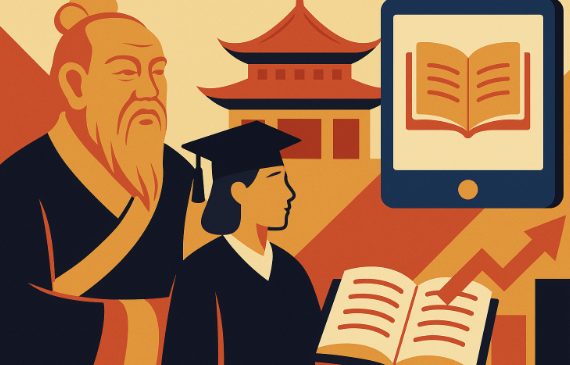
The Dynamics of Balancing Tradition and Modernity in Chinese Education
In ancient China, the common saying was, “To learn without thinking is labor lost; to think without learning is perilous, ” and “Education breeds confidence. Confidence breeds hope. Hope breeds peace”. Reflecting on the wisdom of Confusion, such saying could be heard everywhere from reciting sound of scholars to bedtime stories told by adults. China’s educational system has always combined organized state supervision with deeply ingrained Confucian principles. However, China is also battling neoliberal ideas that see education through the prism of market forces, just as globalization affects educational systems around the globe. A global trend toward treating education as a business where students are viewed more as consumers than learners is highlighted by Mark Fisher’s criticism of neoliberal education. This paper investigates how the Chinese educational system’s modern and traditional reform initiatives are interacting with neoliberal forces, with the potential to change the system’s future course.
For millennia, Confucian principles placed a strong emphasis on moral growth, deference to authority, and the common good shaped Chinese educational thought. These ideas have influenced China’s educational policies and procedures, promoting a system that places a high importance on diligence, self-control, and academic success. The gaokao, a very difficult entrance test that plays a crucial role in choosing Chinese students’ academic and professional fates, is a perfect example of the legacy of these principles. Although I am an international student and have not participated in the gaokao, many of my friends who have experienced it share painfully vivid memories of it. To provide you with more specifics about my cousin’s gaokao experience, her preparations took up nearly all of her daily schedule. She attended classes for up to twenty hours a day, finished a mountain of homework, and studied nonstop for the test. Her busy schedule left little time for other activities, and she developed a tight mental concentration on figuring out the quickest and most effective ways to accurately answer exam questions. Her goals went beyond simply acquiring knowledge; they also included making the most out of every study minute in order to become proficient in the techniques required to ace this difficult exam. This unrelenting pursuit, which echoes the ancient Chinese focus on scholastic endurance and accuracy under duress, emphasizes the severe pressures imposed by the gaokao. After listening to her story, I realized that the gaokao’s demanding style, which emphasizes memorization and difficult examinations above other types of intellectual engagement, is a reflection of ancient ideals of perseverance and diligence.
The Chinese government has a significant influence on educational policy since it strictly regulates the curriculum, the hiring of teachers, and the operations of schools. This centralization guarantees ideological coherence and teaching that is in line with national objectives. However, Mark Fisher’s analysis of neoliberalism points to a rising worldwide trend that is gradually impacting China as well, where educational institutions are perceived as commercial enterprises with an emphasis on profitability and customer pleasure.
Private schools and foreign exchange programs are springing up all over the place in metropolitan areas, targeting the upper class and conforming to market-driven policies that view children as commodities. These schools frequently have expensive tuition, opulent facilities, and a curriculum that emphasizes transferable skills like fluency in English. This method represents a turn away from conventional educational rigor and toward neoliberal ideology, prioritizing commercial needs and consumer happiness over both. The Chinese government retains control over education, striking a balance between innovation and state objectives, even in the face of market-driven developments. The conventional understanding of education as a comprehensive public benefit is put to the test by the move toward market-oriented practices, which highlights the intricate relationship between market forces and state control in China’s educational system.
By taking Fisher’s criticism into consideration, it becomes clear that neoliberal ideas are becoming more and more prevalent in Chinese education, with a special emphasis on consumption. In economically developed areas, where education is increasingly seen as a commodity, this tendency is particularly noticeable. For instance, my parent’s decision to send me to college in the US is indicative of a larger trend in which Chinese families view foreign education as an investment that pays off handsomely, just like they would in customer service. The conventional educational values of academic rigor and human development may be at odds with this consumerist approach. It runs the danger of reducing academic standards because educational institutions may put marketability and student happiness ahead of more difficult courses.
Due to its sizable population and notable urban-rural differences, China has particular problems in the face of the worldwide trend toward neoliberal education. Urban regions’ fierce rivalry for few educational resources puts a great deal of strain on pupils, which frequently results in mental health problems and an unbalanced emphasis on academic achievement at the expense of holistic development. The Chinese government has responded by introducing a number of changes meant to lessen these pressures. Less schoolwork means less stress for students, and encouraging a more balanced lifestyle is one of the initiatives. To lessen the gaokao system’s excessive effect on students’ academic and professional prospects, reforms are also being considered. This is an attempt to lessen the fierce competitiveness that surrounds the exam. Although the Chinese government has started to implement measures to lessen academic expectations, these initiatives could not align with strongly held cultural beliefs toward education. In China, achieving academic success is frequently seen as essential to maintaining family honor and assuring a rich future. Changes like eliminating homework or changing the gaokao’s function may be met with resistance from parents who worry their kids won’t be as competitive in the job market. After internalizing these high standards, students may begin to associate academic success with self-worth. Governmental programs meant to encourage harmony and comprehensive growth may thus be hindered if these deeply ingrained views toward education are not addressed.
China’s educational system is negotiating a challenging environment that is molded by global neoliberal influences, contemporary issues, and traditional beliefs. Fisher makes the argument that the inherent worth of education might be compromised by the emergence of neoliberalism. Through a critical assessment of these effects and the implementation of reforms that place a high priority on equal access and comprehensive education, China may chart a course that balances cultural heritage preservation with the needs of a globalized world. China’s attainment of equilibrium is anticipated to have an impact on its educational achievements, as well as its wider social and economic advancements in the future.
F. Lin